Course Overview
Starting on September 20, 2026
An eagerly awaited 12-week journey into AI Agents – exploring agent architectures, agent patterns, MCP, A2A, prompt optimization, skills, memory streams, and the harness that brings it all together.
The teaching faculty for this workshop comprises the instructor, a supportive staff of teaching assistants, and a workshop coordinator. Together they facilitate learning through close guidance and 1-1 sessions when needed.
You can attend the workshop in person or remotely. State-of-the-art facilities and instructional equipment ensure that the learning experience is invariant of either choice. Of course, you can also mix the two modes: attend the workshop in person when you can, and attend it remotely when you cannot. All sessions are live-streamed, as well as recorded and available on the workshop portal.
Learning Outcome
By the end of the AI Agents Bootcamp, participants will master the core design patterns to engineer effective, practical, real-world AI agent-driven applications. You will have learned techniques to build and optimize high-performance and robust AI agentic solutions. You will gain hands-on experience through labs and real-world use-case driven projects, developing the skills and confidence to solve complex challenges and showcase a strong portfolio.
Schedule
| Start Date | SUNDAY, September 20, 2026 |
|---|---|
| Duration | 12 weeks |
| Session days | Every Sundays |
| Session timing | 11 AM PST to Evening |
| Session type | In-person/Remote |
| Morning sessions | Theory/Paper Readings |
| Evening sessions | Lab/Presentation |
| LAB Walkthrough |
Tuesday, 7 PM to 10 PM Thursday, 7 PM to 10 PM |
| Summary & Quiz | Wednesday, 8.30 AM to 10 AM |
| Clinic Hours | Friday, 8.30 AM to 10 AM |
Call us at 1.855.LEARN.AI for more information.
Skills You Will Learn
Building agents using frameworks such as G-ADK and LangGraph, accessing tools through MCP, inter-agent communication using A2A, prompt optimization, Agentic skills, Agentic memory, Agentic harness
Prerequisites

Focus
Deconstructing the historical, theoretical, and architectural origins of agency, exploring the shift from traditional deterministic programming to goal-seeking autonomous loops, systems thinking, and tool-use maximalism.
Key Takeaways:
- The Modality and Structure of Agency: Distinguishing micromanagement from autonomous delegation, Moravec’s paradox, and the three load-bearing pillars of enterprise AI.
- Tool-Use Maximalism: Cognitive scaffolding, natural language programming vs. microservices, and why comprehensive documentation acts as the primary interface for LLMs.
- The Agentic Loop (ReAct) & Systems Thinking: The fundamental paradigm shift of goal-seeking loops, decomposing non-deterministic multi-step goals into verifiable subgoals, and analyzing high-effort real-world systems.
Lab
- Environment setup and Lab environment, Access to Ray Cluster
- n8n
Focus
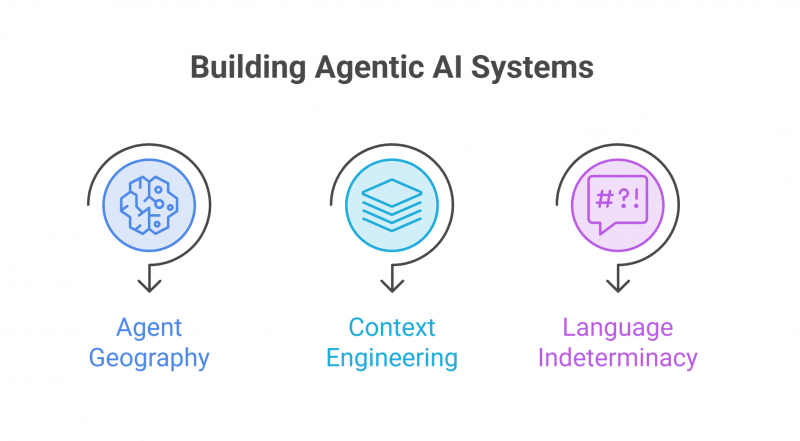
Mastering agent environment interaction topologies, context window mechanics, KV cache token economics, mitigation of context rot, and the hardware and distributed computing principles underlying foundation models.
Key Takeaways:
- Agent Geography & Environmental Interaction: Closed-loop vs. open-loop environments, and parametric vs. non-parametric memory structures.
- Context Engineering & Token Economics: Mitigating the “Lost in the Middle” phenomenon, context rot diagnostics, KV cache reuse economics, and sidecar memory architectures (DeepSeek Engram).
- Indeterminacy in Language Space: The philosophical introduction to epistemic and aleatoric uncertainty, lexical variance vs. semantic core stability, and overcoming developer assumptions via explicit priors.
Lab
- Google ADK Basics
- LangGraph Basics
Focus
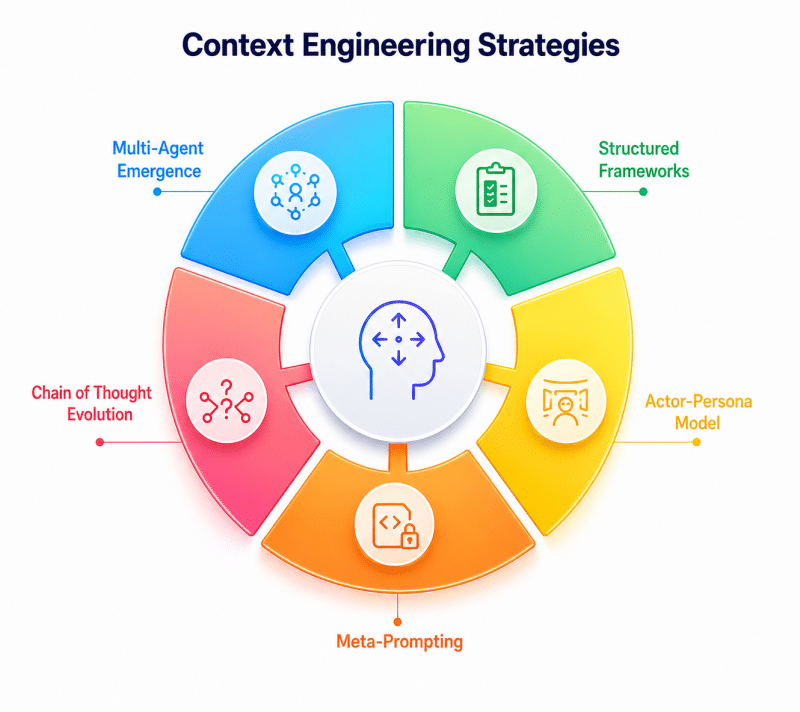
Transforming raw foundational models into specialized, reliable reasoning agents through structured prompt frameworks, multiperspective personas, meta-prompting, and multi-agent social dynamics.
Key Takeaways:
- Structured Frameworks & High-Fidelity Prompting: The Singapore CO-STAR framework, instruction precision, and addressing the critical question: ”What did I leave unsaid?”.
- The Actor-Persona Model: The fly-by-wire control metaphor, steering probability spaces, and multiperspective persona decomposition.
- Meta-Prompting & System Instruction Generation: Synthesizing rigid Pydantic function calling schemas, severity scoring, and automated system instruction hardening.
- Chain of Thought Evolution & Reasoning Substrates: Analysis of CoT latency/cost overheads, self-consistency quorums, and the declining need for manual CoT in modern frontier reasoning models.
- Multi-Agent Emergence & Social Dynamics: Reconstructing the Stanford *Generative Agents (Simulacra)* architecture, memory stream reflection, and emergent coordination.
Lab
- Prompting Techniques

Focus
Automated evaluation harnesses, actor-critic architectures, and decoupled prompt robustness testing.
Key Takeaways:
- Actor-Critic Architectures & Automated Testing: Decoupled parameter scaling in multi-agent reviewer loops, DAG-based critique networks, and automated prompt robustness evaluation with Promptfoo.
Lab
- Promptfoo
Focus
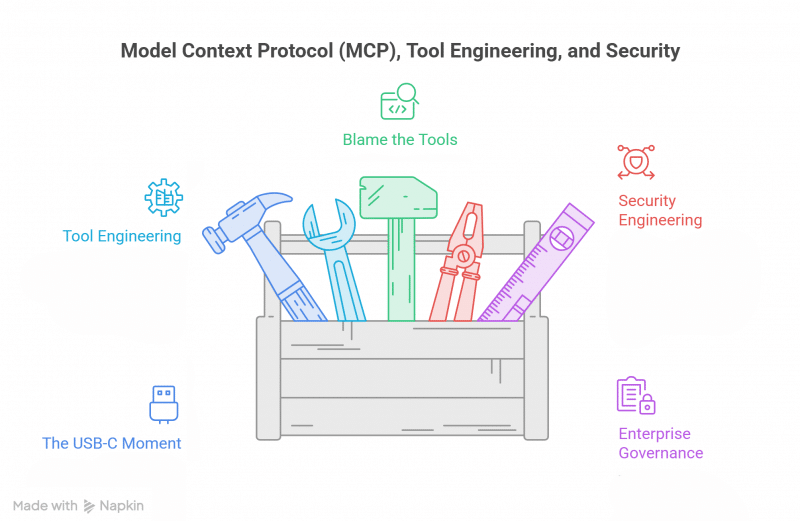
Engineering robust, secure, and standardized tool interfaces for language models using the Model Context Protocol (MCP), establishing strict contracts, and defending against enterprise agent security vulnerabilities.
Key Takeaways:
- The USB-C Moment for AI: Anthropic’s unopinionated Model Context Protocol (MCP), decoupling agents from point-to-point tool APIs, and transitioning from stream pipelines to async function interfaces.
- Tool Engineering & Design by Contract: Strict schema typing, tool politeness (information density vs. token bloat), Single Responsibility Principle (SRP), and symmetric mitigations (extraction and garbage collection).
- The “Blame the Tools” Philosophy: FastMCP server construction, LightLLM abstraction layers, and tracing execution failures to ambiguous docstrings rather than model stochasticity.
- Security Engineering & Threat Vectors: Deconstructing the 16 MCP threat scenarios, tool poisoning via docstrings, typo-squatting, tool rugpulling, and indirect prompt injection.
- Enterprise Agent Governance: The Microsoft Governance Toolkit, OWASP Top 10 for LLMs/Agents, just-in-time privilege escalation, and dynamic intent drift tracking.
Lab
- Google ADK – MCP and OAuth
Focus
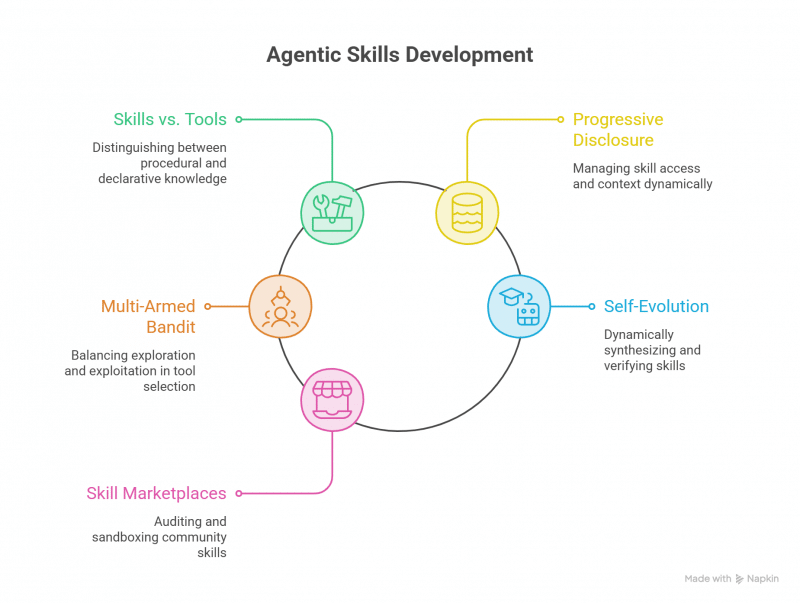
Architecting modular, composable, and progressive skill libraries for AI agents, navigating the exploration-exploitation dilemma with multi-armed bandits, and implementing file-system-driven cognitive scaffolding.
Key Takeaways:
- Skills vs. Tools Abstraction: Procedural knowledge (“knowing-how”) vs. declarative interfaces (“knowing-that”), pure skills vs. tool-using skills, and progressive disclosure architecture.
- Progressive Disclosure & Scoping: Preamble strategies, project-level skill scoping via the CLI, resolving global namespace collisions, and dynamic context injection.
- The Multi-Armed Bandit Paradigm: Balancing exploration vs. exploitation in agent tool selection, $\epsilon$-greedy strategies, regret minimization, and bell-curve reward distributions.
- Self-Evolution: Dynamic skill synthesis, automated code-level verification, and iterative curriculum evolution in open-ended environments.
- Skill Marketplaces & Governance: Anti-patterns of “God Skills”, auditing untrusted community skills, and least-privilege runtime sandboxing.
Lab
- Using Skills with Google ADK Agents
Focus
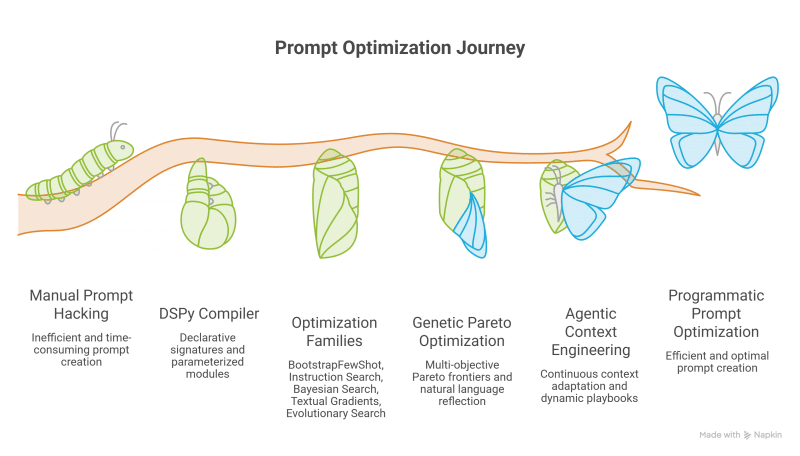
Moving beyond manual prompt hacking by compiling natural language declarations with DSPy, Genetic-Pareto optimization (GEPA), Bayesian search (MIPROv2), textual gradients (TextGrad), and Agentic Context Engineering (ACE).
KeyTakeaways:
- Mathematical Foundations of Prompt Optimality: Discrete linguistic gradients, the metric operator $\mu$, Goodhart’s Law in prompt compilation, and calculating the 10-minute Headroom pre-flight test.
- The DSPy Compiler Paradigm: Declarative Signatures, parameterized Modules, and compiling natural language pipelines into optimal few-shot exemplars and instructions.
- Six Families of Prompt Optimization: BootstrapFewShot, Instruction Search (COPRO), Bayesian joint-space search (MIPROv2), Textual Gradients (TextGrad), and Evolutionary Search (APE, Prompt Breeder).
- Genetic Pareto Optimization (GEPA) vs. RL/GRPO: Multi-objective Pareto frontiers, natural language reflection side-channels vs. opaque scalar rewards, and mutation/crossover mechanics.
- Agentic Context Engineering (ACE): Continuous context adaptation vs. fine-tuning, dynamic playbook ledgers, delta updates, and mitigating brevity bias and context collapse.
Lab
- DSPy Basics
- DSPy Optimizers
Focus
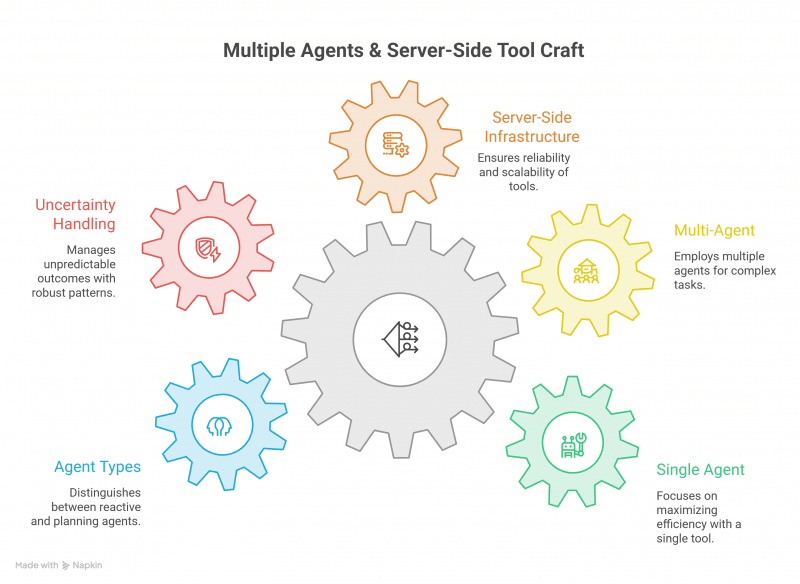
Determining when to scale from single tool-maximalist agents to multi-agent topologies, enforcing server-side reliability, and handling aleatoric uncertainty with robust engineering patterns.
- Key Takeaways:
Single vs. Multi-Agent Dilemma: Avoiding premature multi-agent complexity, the planetary motion analogy, and evaluating the hidden costs of latency and token velocity. - Server-Side Tool Infrastructure: Hardening Python backends, Ray Inference Server for high-concurrency MCP hosting, and treating tools as enterprise-grade infrastructure.
- Handling Aleatoric Uncertainty & Fault Tolerance: Idempotency keys for non-deterministic model retries, deduplication with Bloom Filters, and probabilistic sketching algorithms (HyperLogLog, Count-Min Sketch).
- System 1 vs. System 2 Agent: Partitioning reactive single-step execution from deliberate, multi-hypothesis planning and evaluation.
Lab
- Server-Side Tool Infrastructure &
- Idempotency Patterns
Multi-Agent Vacation Planning System (System 1 vs. System 2)
Focus
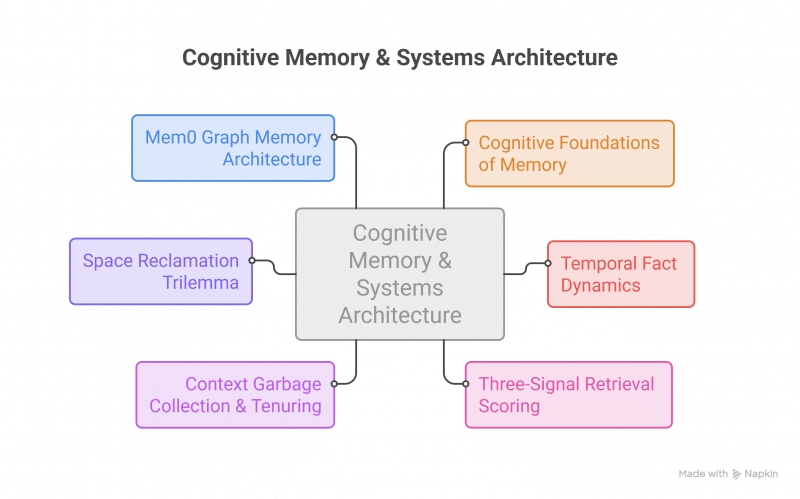
Grounding agent memory in cognitive science and operating systems theory, engineering multi-tiered memory stores, temporal decay mechanics, context garbage collection, generational heap promotion, and graph-relational memory mapping.
Key Takeaways:
- Cognitive Foundations of Memory: Tulving’s distinction (Episodic vs. Semantic), Squire’s declarative vs. procedural models, Baddeley’s working memory desk, and the four agentic memory tiers (Working, Episodic, Semantic, Procedural).
- Temporal Fact Dynamics: The Zombie Fact Problem, handling contradiction vs. evolution, and the four verbs of memory (Write, Read, Consolidate, Forget).
- Three-Signal Retrieval Scoring: Unifying Park et al.’s scoring function (Recency $\times$ Importance $\times$ Relevance) with Ebbinghaus forgetting curves and cache eviction theory.
- Context Garbage Collection & Tenuring: JVM heap vs. agent context window, generational tenuring (young vs. old pools), tombstoning stale facts, and multiplicative veto scoring formulas.
- The Space Reclamation Trilemma: The architectural tradeoff between Compression (summaries), Delegation (sub-agents as stack frames), and Externalization (MemGPT paging), alongside GDPR compliance governance.
- Mem0 Graph Memory Architecture: Mem0 Architecture and Memory Lifecycle, Graph extraction pipelines, resolving cross-turn contradictions via graph edges, subgraph query retrieval protocols, and choosing the Appropriate Memory Architecture.
Lab
- Agent Memory Labs (Google ADK)
- Mem0, and other Memory frameworks
Focus
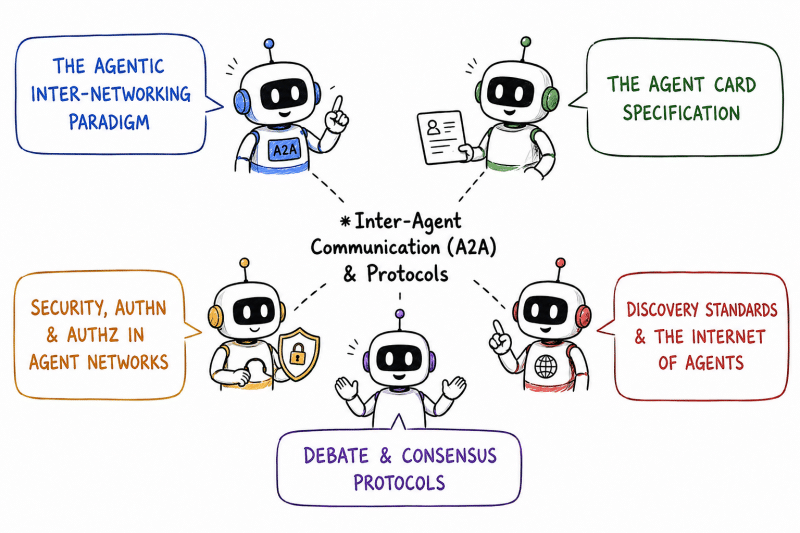
Scaling multi-agent collaboration to internet-scale distributed systems using the Agent-to-Agent (A2A) protocol, dynamic capability discovery via Agent Cards, debate protocols, and decentralized governance.
Key Takeaways:
- The Agentic Inter-Networking Paradigm: Scaling beyond isolated monoliths, the $N^2$ communication explosion, and comparing A2A protocols against traditional REST/gRPC APIs.
- The Agent Card Specification: Declarative capability advertisement, caller expectations, non-deterministic contract negotiation, and distinguishing MCP tools from Agent Cards.
- Security, AuthN & AuthZ in Agent Networks: The propagation problem in Role-Based Access Control (RBAC), just-in-time authorization delegation, and preventing multi-agent sycophancy.
- Debate & Consensus Protocols: Multi-agent cooperation patterns, voting mechanics, the consensus prompt, and adversarial cross-reflection verification loops.
- Discovery Standards & The Internet of Agents: Intent-based routing registries, Cisco Agency, the NANDA protocol, and building decentralized enterprise agent networks.
Lab
- A2A with G-ADK
- A2A with LangGraph + Agent Registry
Focus
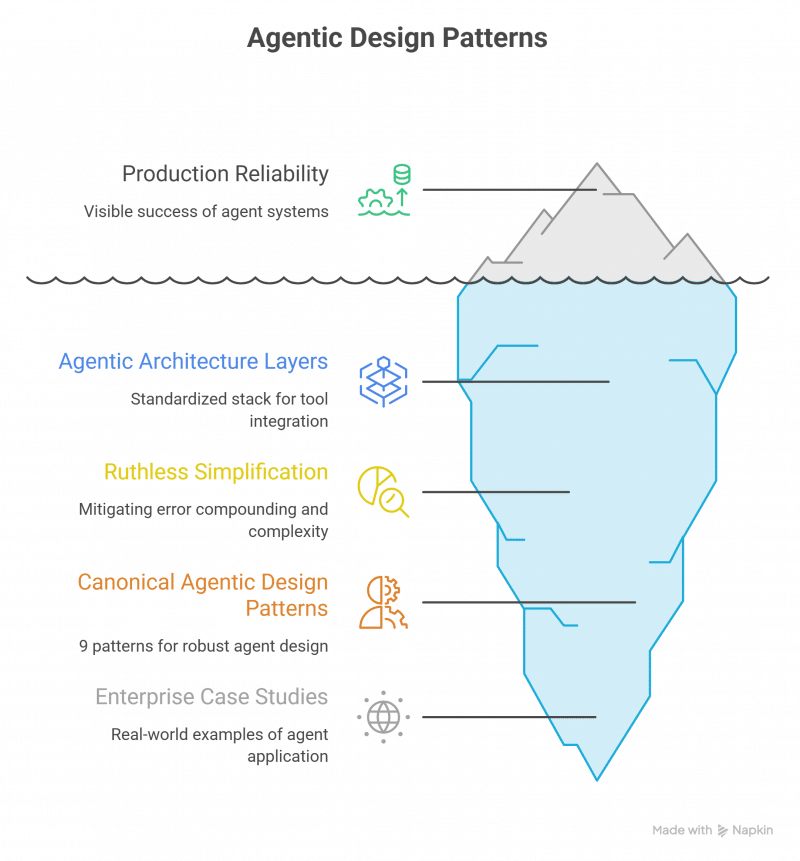
Mastering enterprise agent architecture layers, applying the doctrine of ruthless simplification, and implementing the 9 canonical agentic design patterns for production reliability.
Key Takeaways:
- The Agentic Architecture Layers: Standardizing the stack across Tool Integration (MCP), Collaboration (A2A), Development SDKs (Google ADK / LangGraph), and Trust Registries (NANDA).
- The Doctrine of Ruthless Simplification: Mitigating the mathematics of error compounding ($P(\text{success}) = p^n$), the “Half-Baked Physician” principle, and the 4-question architectural decision framework.
- The 9 Canonical Agentic Design Patterns:
1. Sequential Pipeline (deterministic staging)
2. Router & Dispatcher (intent triage)
3. Parallel Fan-Out / Fan-In (MapReduce decomposition)
4. Orchestrator-Workers (dynamic delegation)
5. Evaluator-Optimizer (generate-critique loop)
6. Group Chat & Council (multi-expert debate)
7. Dynamic Handoff (state transfer)
8. Task Ledger / Adaptive Planning Manager (living execution state)
9. Explicit State Machine (rigid business constraints) - Enterprise Case Studies: Supply chain orchestration (Tyson Foods), SRE incident resolution (Resolve.ai), and multi-agent customer service networks (Salesforce Agentforce).
Lab
- Agentic Design Patterns (Implementing the 9 canonical enterprise topologies)
Focus
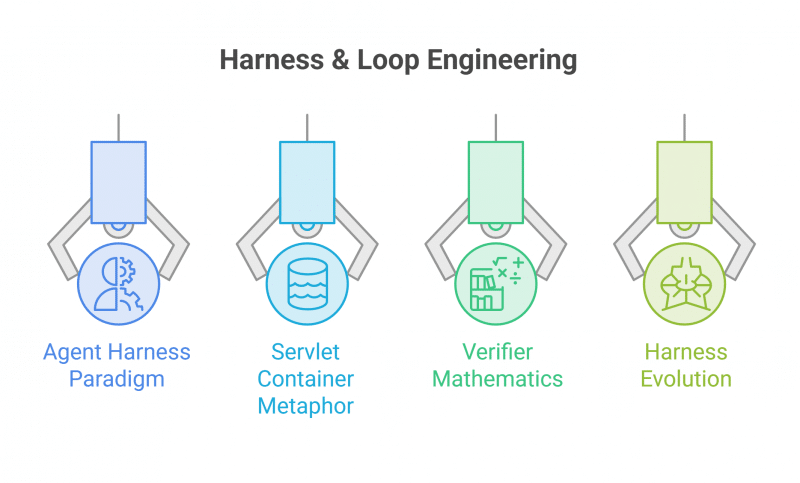
Treating the agent harness as the core differentiator of system performance, applying cybernetic control systems theory, designing machine verifiers, and engineering fail-safe execution runtimes.
Key Takeaways:
- The Agent Harness Paradigm: “The Model Proposes, The Harness Disposes” — the Seven Verbs of a Harness, micro-architectural yield boundaries, watchdog timers, and Write-Ahead Logging (WAL).
- The Servlet Container Metaphor: Mapping Tomcat/WebLogic lifecycle management, thread pooling, declarative sandboxing, and transaction rollbacks to agentic runtimes.
- Verifier Mathematics & Information Theory: Hard verifiers vs. soft LLM judges vs. human-in-the-loop, precision ceiling formulas, and defining immutable exit conditions.
- Harness Evolution Across Model Generations: Early multi-agent brittle scaffolding vs. modern minimalist harnesses powered by high-capability base models.
Lab
- Agentic Harness Verifier Loops & Control Systems
- Watchdog & Loop Breaker Engineering
Focus
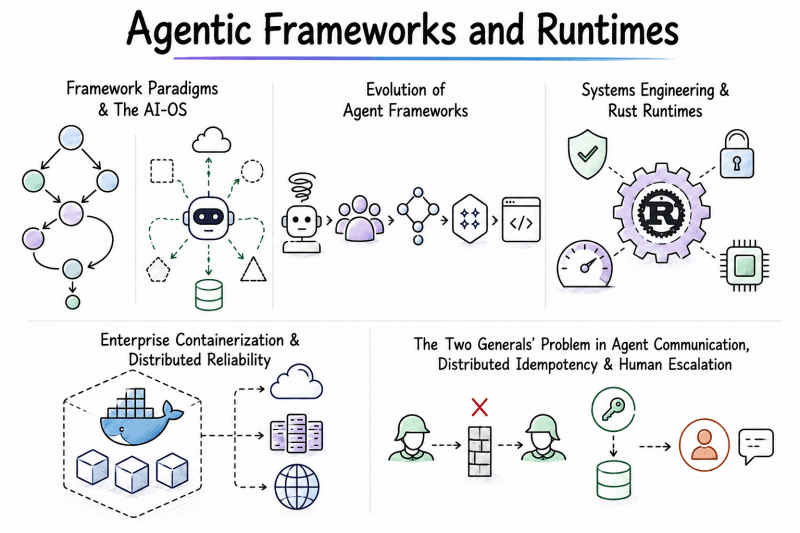
Evaluating framework paradigms (AI-OS vs Graph-centric), benchmarking modern agent frameworks, dissecting runtime architectures, and enterprise containerization.
Key Takeaways:
- Framework Paradigms & The AI-OS: Graph-centric workflow topologies (LangGraph) vs. dynamic runtime discovery (Google ADK), and treating agent runtimes as modern operating systems.
- Evolution of Agent Frameworks: The AutoGPT autopsy (self-amplification bias and missing machine verifiers), CrewAI role constraints, LangGraph state graphs, Pydantic AI, and SDK-first harnesses.
- Systems Engineering & Rust Runtimes: Transitioning to systems programming for agent harnesses, memory safety, concurrency, and evaluating frameworks with HarnessBench.
- Enterprise Containerization & Distributed Reliability: The Two Generals’ Problem in agent communication, distributed idempotency keys, and asynchronous human escalation workflows.
Lab
- Framework Benchmarking (Google ADK vs. LangGraph vs. CrewAI)
Focus
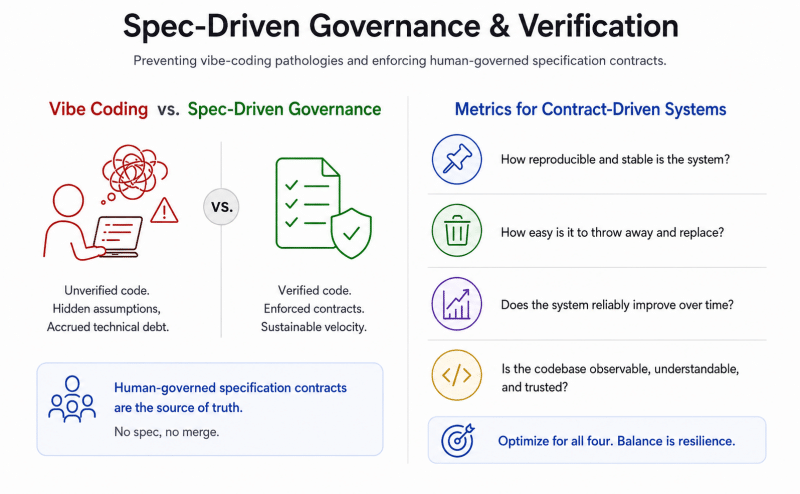
Preventing vibe-coding pathologies, enforcing human-governed specification contracts, and implementing mutation testing and contract-driven metrics for resilient agentic codebases.
Key Takeaways:
- Vibe Coding vs. Spec-Driven Governance: The technical debt of unverified vibe coding, mutation testing for generated code, and enforcing human-governed specification contracts.
- Metrics for Contract-Driven Systems: The 4 metrics of resilient agentic codebases: Pinning, Disposability, Convergence, and Lit Code.
Lab
- Spec-Driven Verification Contracts & Mutation Testing
Focus
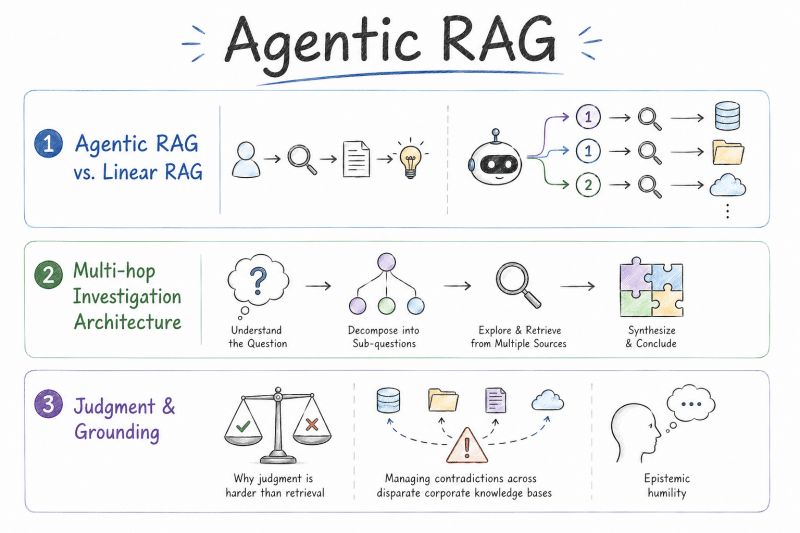
Unifying exploratory retrieval with autonomous reasoning and deconstructing multi-hop investigation architectures.
Key Takeaways:
- Agentic RAG vs. Linear RAG: Multi-hop query decomposition, the Librarian investigation analogy, HyDE query expansion, and adaptive retrieval routing.
- Judgment & Grounding: Why judgment is harder than retrieval, managing contradictions across disparate corporate knowledge bases, and epistemic humility.
Lab
- Agentic RAG
Focus
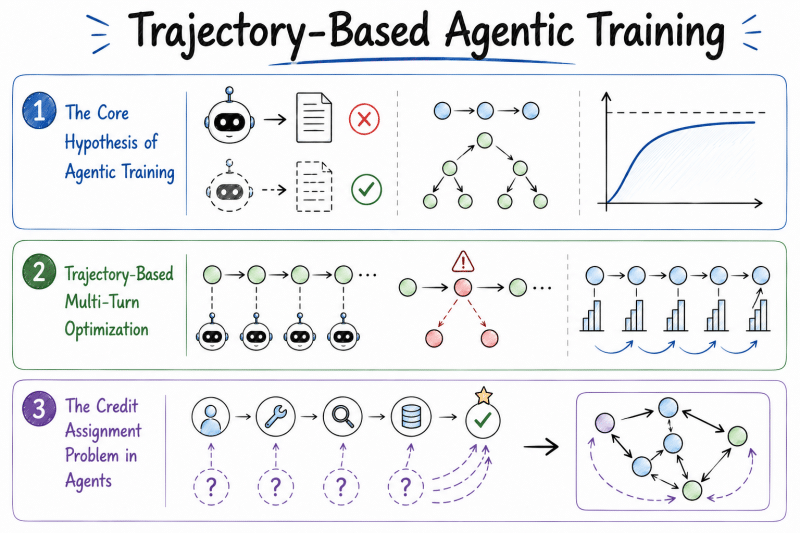
Training agents using multi-turn trajectory rollouts and credit assignment.
Key Takeaways:
- The Core Hypothesis of Agentic Training: The failure of single-turn imitation learning (SFT), the deterministic vs. stochastic divide, and why prompt engineering hits saturation ceilings.
- Trajectory-Based Multi-Turn Optimization: Generating sequential rollouts, identifying branching points of failure, and shifting token probabilities across multi-step execution traces.
- The Credit Assignment Problem in Agents: Distributing sparse episodic rewards across intermediate tool calls and decisions, and automated backpropagation with Microsoft Agent Lightning.
Lab
- Agent Lightning
In-Person vs Remote Participation
Teaching Faculty
Asif Qamar
Chief Scientist and Educator
Background
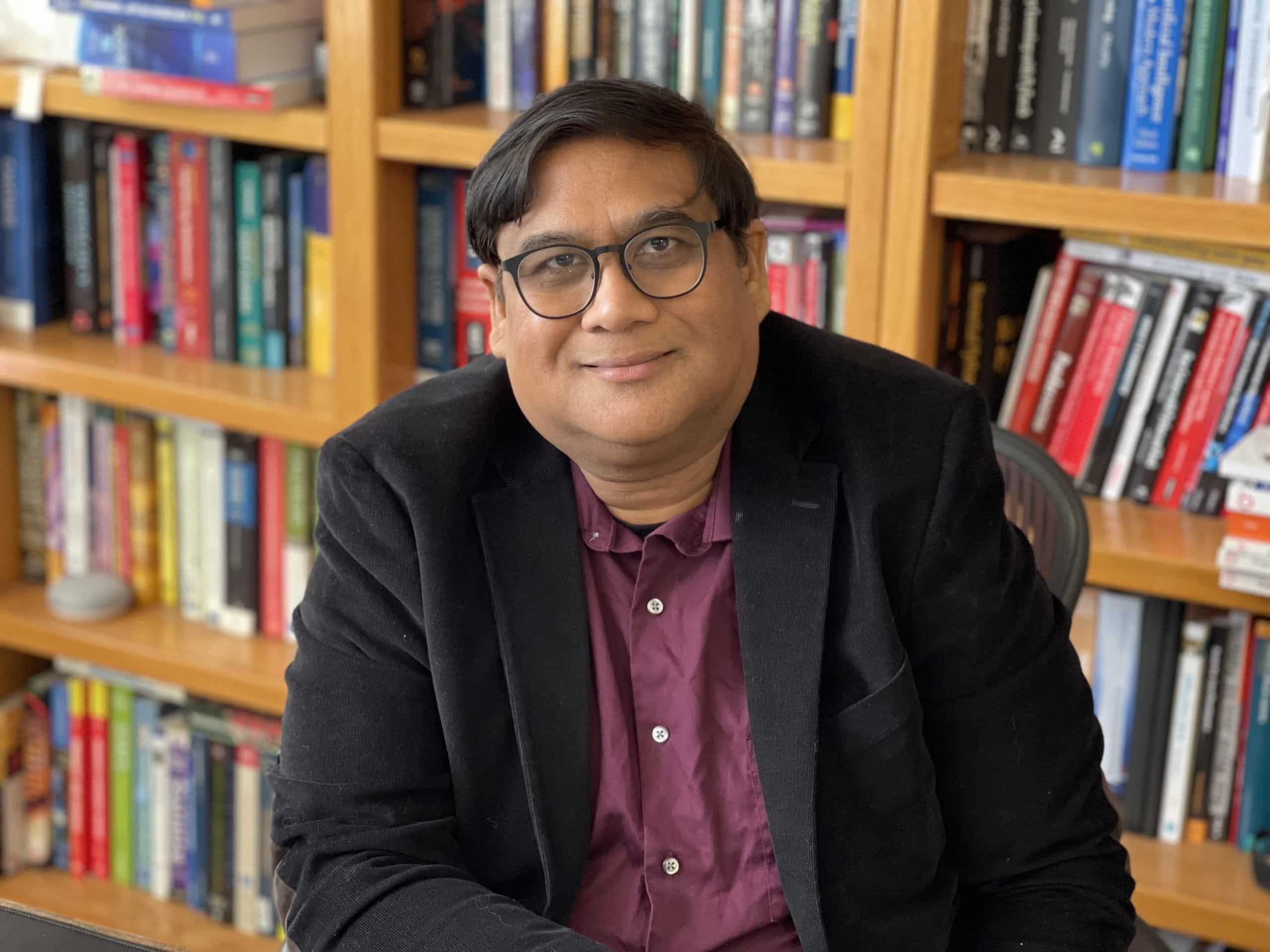
Over more than three decades, Asif’s career has spanned two parallel tracks: as a deeply technical architect & vice president and as a passionate educator. While he primarily spends his time technically leading research and development efforts, he finds expression for his love of teaching in the courses he offers. Through this, he aims to mentor and cultivate the next generation of great AI leaders, engineers, data scientists & technical craftsmen.
Educator
He has also been an educator, teaching various subjects in AI/machine learning, computer science, and Physics for the last 32 years. He has taught at the University of California, Berkeley extension, the University of Illinois, Urbana-Champaign (UIUC), and Syracuse University. He has also given a large number of courses, seminars, and talks at technical workplaces. He has been honored with various excellence in teaching awards in universities and technical workplaces.
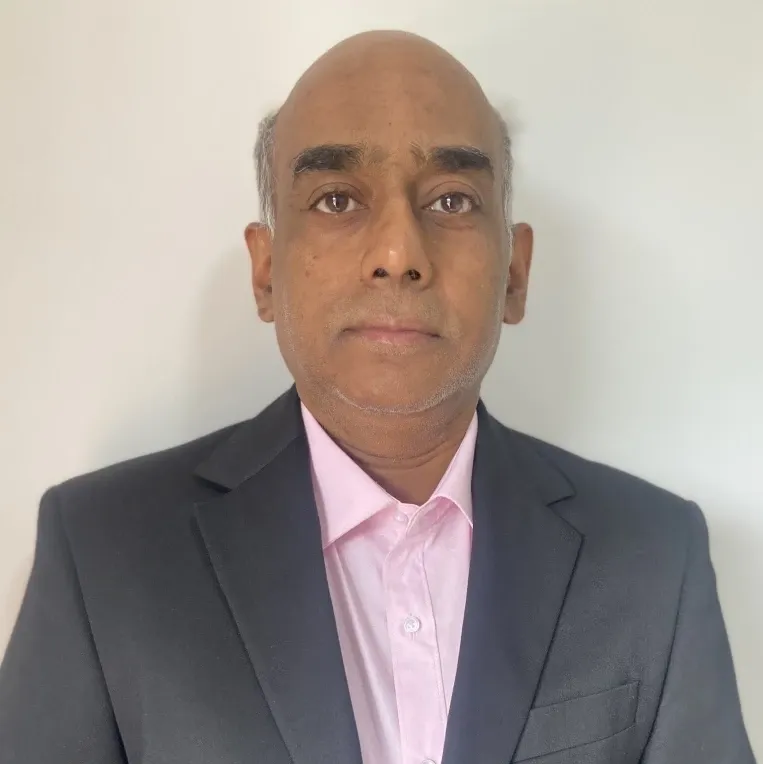
Chandar Lakshminarayan
Head of AI Engineering
Background
A career spanning 25+ years in fundamental and applied research, application development and maintenance, service delivery management and product development. Passionate about building products that leverage AI/ML. This has been the focus of his work for the last decade. He also has a background in computer vision for industry manufacturing, where he innovated many novel algorithms for high precision measurements of engineering components. Furthermore, he has done innovative algorithmic work in robotics, motion control and CNC.
Educator
He has also been an educator, teaching various subjects in AI/machine learning, computer science, and Physics for the last decade.
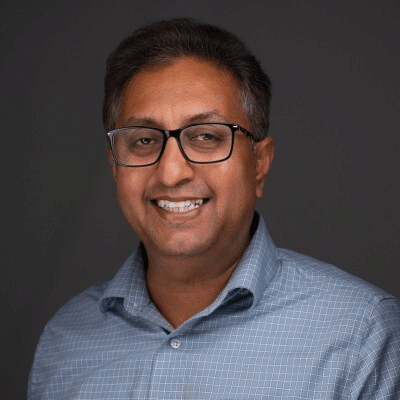
Krishnan Ramaswamy
Co-Instructor
Background
Krishnan Ramaswamy is an engineering leader, AI practitioner, and educator with an M.S. in Computer Science and Engineering and more than 25 years of industry experience. Throughout his career, he has designed and delivered large-scale platforms, enterprise applications, and AI/ML-driven solutions across Collaboration, Security, and Customer Experience domains. His expertise includes AI engineering, large language models, retrieval systems, agent architectures, distributed systems, and enterprise platform development. He is passionate about transforming emerging research into production-ready solutions that deliver measurable business value.
Educator
As a co-instructor at SupportVectors, Krishnan mentors engineers and technology professionals on modern AI engineering practices, helping them understand not only how AI systems are built, but also how they can be deployed, evaluated, governed, and scaled in enterprise environments. His teaching combines deep technical knowledge with real-world experience gained from decades of building and leading engineering initiatives.
Teaching Assistants
Our teaching assistants will guide you through your labs and projects. Whenever you need help or clarification, contact them on the SupportVectors Discord server or set up a Zoom meeting.

Kate Amon
Univ. of California, Berkeley

Shubeeksh K
MS Ramaiah Institute of Technology

Purnendu Prabhat
Kalasalingam Univ.

Harini Datla
Indian Statistical Institute

Kunal Lall
Univ. of Illinois, Chicago