Course Overview
Starting on Saturday, September 19, 2026
This is the eagerly awaited 12-week bootcamp that takes you deep into the world of LLMs, RAG, fine-tuning, and MLOps—and equips you to build production-ready GenAI systems.. This course bridges foundational machine learning theories with enterprise-scale engineering practices..
You will work in teams of 4–6 engineers in an environment that reflects the innovation-driven spirit of Silicon Valley. Participants will have access to a state-of-the-art AI training datacenter featuring 20+ GPU servers and 40+ NVIDIA GPUs, including RTX PRO 6000 Blackwell, RTX 5090, and RTX 4090 systems.
The infrastructure will be available throughout the boot camp for hands-on training, experimentation, model development, and collaborative AI projects, with both on-site and remote access support.
Learning Outcome
You should become confident and fluent in applying LLMs to a wide range of real-world problems, while developing deep theoretical and hands-on expertise in RAG, fine-tuning, and MLOps practices for deploying, evaluating, monitoring, and continuously improving LLM applications in production.
Hands-on experience across the GenAI stack, spanning vector embeddings, semantic search, RAG, multimodal learning, video comprehension, computer vision, audio processing, and NLP, complemented by prompt engineering, fine-tuning, and MLOps/LLMOps for taking GenAI applications from experimentation to production.
Schedule
| START DATE | SATURDAY, September 19, 2026 |
|---|---|
| Periodicity | Meet every Saturday for twelve weeks |
| Schedule | From 11 AM to 5 PM PST |
| Morning Session | 11 AM to 1 PM PST |
| Lunch Served | 1 PM to 1:30 PM PST |
| Afternoon Session | 1:30 PM to 4 PM PST |
| Project Presentations | 4 PM to 5 PM |
| Lab Walkthrough | Monday, 7 PM to 10 PM Wednesday, 7 PM to 10 PM |
| Summary & Quiz | Tuesday, 8.30 AM to 10 AM |
| Clinic Hours | Thursday, 8.30 AM to 10 AM |
Skills You Will Learn
Hands-on experience across the GenAI stack, spanning vector embeddings, semantic search, RAG, multimodal learning, video comprehension, computer vision, audio processing, and NLP, complemented by prompt engineering, fine-tuning, and MLOps/LLMOps for taking GenAI applications from experimentation to production.
Prerequisites
Syllabus details
Focus
Key Takeaways:
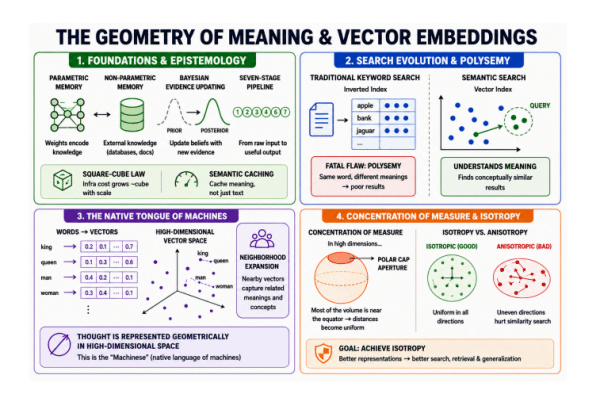
- Foundations & Epistemology: Exploring parametric vs. non-parametric memory, Bayesian evidence updating, the Seven-Stage Pipeline, Square-Cube law, and semantic caching.
- Search Evolution & Polysemy: Inverted index architecture, the fatal flaw of polysemy, and lexical vs. semantic search dynamics.
- The Native Tongue of Machines: Representing thought geometrically as high-dimensional vectors (“Machinese”), orthogonal properties, and spatial neighborhood expansion.
- Concentration of Measure & Isotrophy: The blessing of high dimensions, polar cap apertures, and mitigating anisotropy.
Lab
- Environment setup and Lab environment, Access to Ray Cluster
- Animal RAG, SV RAG
Focus
Key Takeaways:
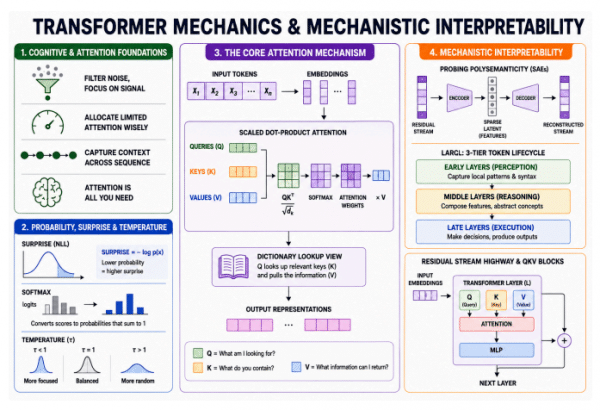
- Cognitive & Attention Foundations: Sensory noise isolation, finite resource distribution, sequence-to-sequence latent capture, and the Attention Is All You Need paradigm.
- Probability, Surprise & Temperature: Information-theoretic surprise, Negative Log-Likelihood (NLL), softmax normalization mechanics, and temperature as a sampling viscosity throttle.
- The Core Attention Mechanism: Query, Key, and Value vector formulation, the scaled dot-product attention equation, and dictionary lookup dynamics.
- Mechanistic Interpretability & LarQL: Probing polysemanticity with Sparse Autoencoders (SAEs), LarQL 3-tier token lifecycle (Early/Middle/Late layers), and the residual stream highway with QKV projection blocks
Lab
- Contrastive Loss
-
LarQL: Querying open-weight model internals as relational databases
Focus
Key Takeaways:
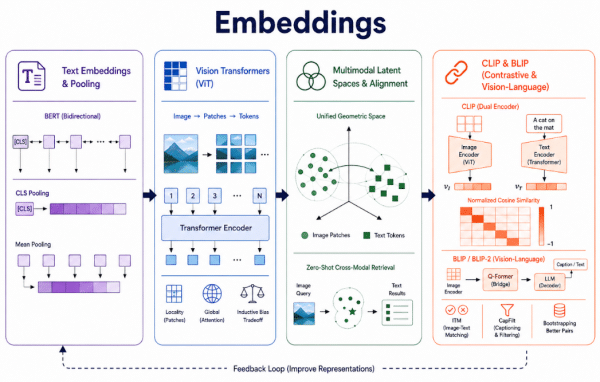
- Text Embeddings & Pooling Strategies: Deep bidirectional transformers (BERT), pre-training vs. fine-tuning transfer learning, and distilling sequence context via CLS and mean pooling.
-
Vision Transformers (ViT): Patch-based linear projection (“An Image is Worth 16×16 Words”), visual tokens as vocabulary, locality vs. global attention, and inductive bias tradeoffs in parameter efficiency.
-
Chunking & Latent Spaces: Semantic and hierarchical chunking, the paradigm shift of Late Chunking, and contextual chunking.
- Cross-Modal Alignment, CLIP Architecture & Contrastive Learning: Dual-encoder topology, learning visual representations from raw text supervision, and normalized cosine similarity matrices.
-
BLIP & BLIP-2 Vision-Language Frameworks: Unifying understanding and generation, Cross-Attention mechanisms, Image-Text Matching (ITM), and bootstrapping via Captioning and Filtering (CapFilt).
Lab
-
Embedding Basics
-
Vision language understanding(CLIP, BLIP, BLIP-2)
Focus
Key Takeaways:
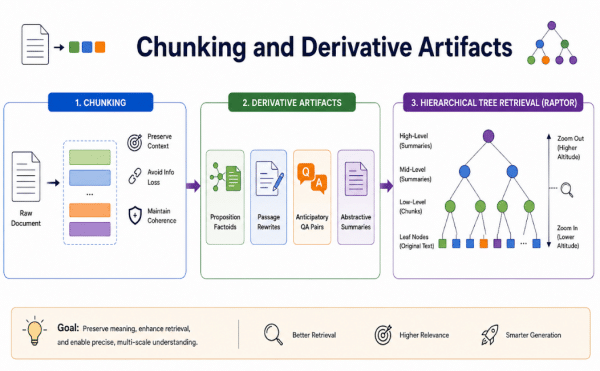
- Chunking & Failure Modes: Context rot, knapsack problem, the centroid delusion in large chunks, and endophora / grammatical anchor severance.
- State-of-the-Art Chunking & Visual Modalities: Contextual chunking, late chunking.
- Derivative Artifacts: Pre-computed proposition factoids, passage rewrites, anticipatory QA pairs, and abstractive summarization to align document registers with search intent.
- Hierarchical Tree Retrieval (RAPTOR): Gaussian clustering of semantic embeddings, recursive summarization trees, and “zoom lens” multi-altitude navigation.
Lab
- Chunking strategies
- Contextual chunking, Late chunking
- Derivative artifacts
- RAPTOR using library
Focus
Key Takeaways:
-
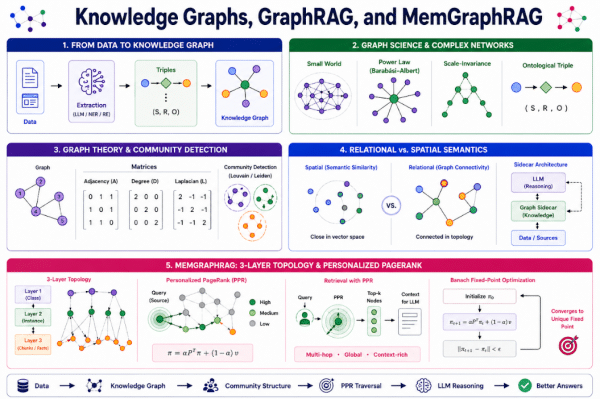
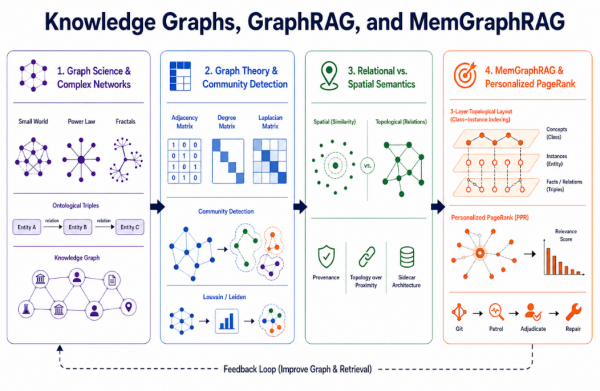
Graph Science & Complex Networks:
Small world phenomena, power laws (Barabási–Albert), scale-invariance / fractals, and ontological triples. -
Graph Theory & Community Detection:
Adjacency, degree, and Laplacian matrices, modularity maximization, and Louvain / Leiden partitioning algorithms. -
Relational vs. Spatial Semantics:
Continuous spatial proximity vs. topological connectivity, perfect data provenance, and the Sidecar architecture pattern -
MemGraphRAG & Personalized PageRank:
3-layer topological layout (class-instance indexing), Personalized PageRank semantic energy diffusion, and Banach fixed-point optimization.
Lab
-
GraphRAG
-
LightRAG
Focus
Key Takeaways:
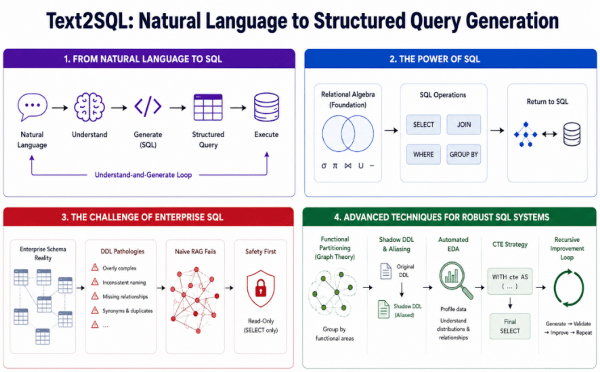
- The Evolution of Code and Understanding: From natural language to binary, and the core process of understand-and-generate.
- The Enduring Power of SQL: Relational algebra origins, fundamental SQL operations, the NoSQL misconception, and the return to SQL.
- The Challenge of Enterprise SQL Generation: Enterprise schema reality, DDL pathologies, the insanity of naive RAG, and read-only safety protocols.
-
Advanced Techniques for Robust SQL Systems:
Functional partitioning via graph theory, the Shadow DDL and aliasing, automated Exploratory Data Analysis (EDA), the Common Table Expression (CTE) strategy, and the recursive improvement loop.
Lab
-
Text2SQL from First Principles
Focus
Key Takeaways:
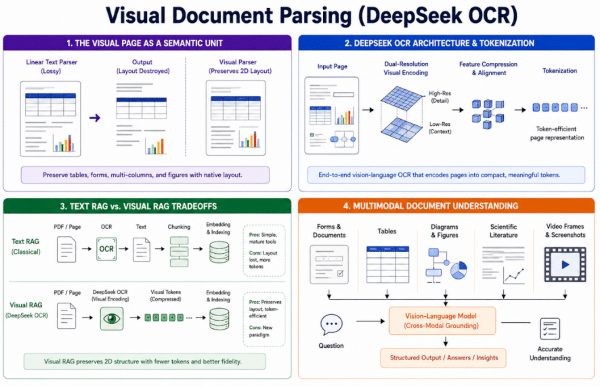
- The Visual Page as a Semantic Unit: Overcoming spatial document layout destruction caused by linear text parsers on tables, forms, and multi-column figures.
- DeepSeek OCR Architecture & Tokenization: End-to-end vision-language optical character recognition, dual-resolution visual encoding, and compressing high-resolution page features.
- Text RAG vs. Visual RAG Tradeoffs: Comparing classical OCR-plus-chunking pipelines against direct visual embedding indexing and token-efficient page representations.
- Multimodal Document Understanding: Cross-modal grounding for structured forms, diagrams, scientific literature, and video frame chunking.
Lab
-
Visual document parsing (DeepSeek OCR)
-
Text RAG vs. Visual RAG
Focus
Key Takeaways:
-
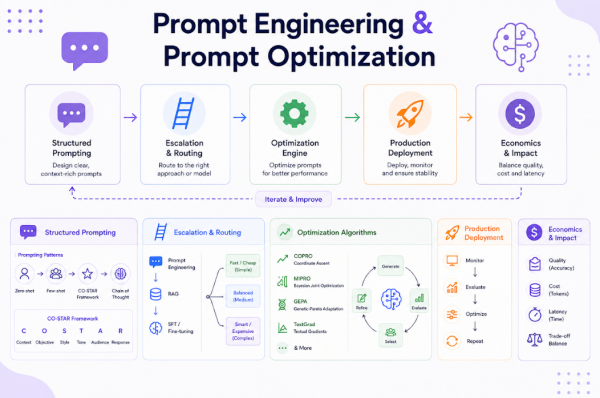
Prompt Robustness & Epistemic Uncertainty:
Human ambiguity vs. machine predictability, and the escalation ladder. - Structured Prompting Frameworks: Zero-shot and few-shot pattern setting, the CO-STAR framework, metaprompting, and Chain of Thought reasoning vs. non-reasoning models.
- The AI Escalation Ladder & Model Routing: Prompt Engineering → RAG → SFT: Capability Tiers, Epistemic Capacity Saturation, Model-Routing Economics, and the Anti-Pattern
- DSPY: Declarative signatures, parameterized modules, the optimizer as a natural language compiler, and the PyTorch paradigm in prompting.
- Optimization Algorithms: COPRO coordinate ascent, MIPRO Bayesian joint-space optimization, GEPA genetic-Pareto adaptation, TextGrad backpropagation in natural language, and evolutionary frameworks (APE, Prompt Breeder, EvoPrompt).
- Production Stability & Economics: The four variables of silent prompt degradation, model sunsetting and prompt migration, semantic core vs. linguistic variation, and token economics.
Lab
-
Prompt Engineering
-
Prompt Optimization: DSPy Basics, DSPy Optimizers
Focus
Key Takeaways:
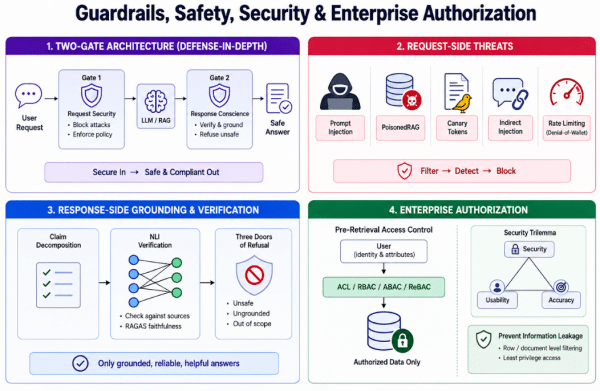
- Core Mental Models & Two-Gate Architecture: The Wizard of Oz inversion, Gate 1 (Request security) vs. Gate 2 (Response conscience), and defense-in-depth.
- Request-Side Threat Vectors: Prompt injection, PoisonedRAG, canary tokens, indirect injection, and rate limiting / denial-of-wallet protections.
- Response-Side Grounding & Verification: Structural claim decomposition, bipartite graph modeling, RAGAS faithfulness triad, NLI execution, and the Three Doors of Refusal.
- Enterprise Authorization & Entitlements: The RAG security trilemma, pre-retrieval ACL/RBAC/ABAC/ReBAC filtering, and surfaces of information leakage.
Lab
-
Input Guardrails
-
Response Grounding
Focus
Key Takeaways:
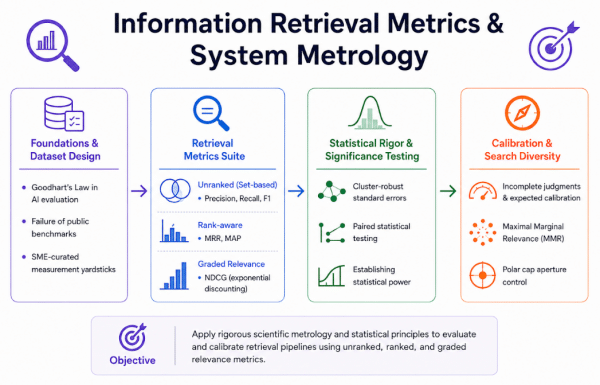
- Foundations of Metrology & Dataset Design: Goodhart’s Law in AI evaluation, failure of public benchmarks, and SME-curated measurement yardsticks.
- Retrieval Metrics Suite: Unranked metrics (Precision, Recall, F1), rank-aware metrics (MRR, MAP), and graded relevance (NDCG with exponential discounting).
-
Statistical Rigor & Significance Testing: Cluster-robust standard errors, paired statistical testing, and establishing statistical power.
- Calibration & Search Diversity: Incomplete judgments, expected calibration, and Maximal Marginal Relevance (MMR) for polar cap aperture control.
Lab
-
Retrieval metrics
Focus
Key Takeaways:
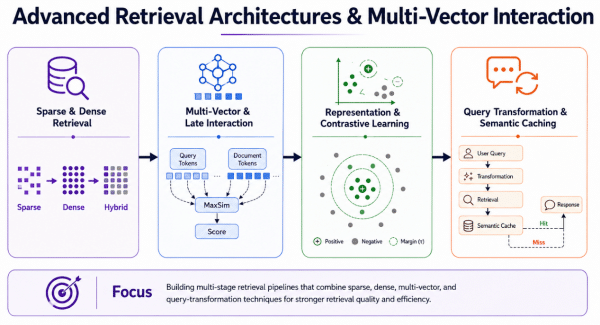
- Sparse, Dense & Multi-Vector Models: BM25, SPLADE contextual sparse expansion, ColBERT token-level late interaction (MaxSim), and Matryoshka Representation Learning (MRL).
- Contrastive Learning & Loss Dynamics: InfoNCE mechanics, temperature (tau) viscosity throttle, Decoupled Contrastive Loss, and the Long Context Mirage.
-
Query Transformation & Semantic Caching: Query pathologies/verbs, HyDE (crossing register gaps), and semantic cache threshold mechanics.
Lab
-
Matryoshka Representation Learning
-
Retrieval Funnel
-
Query Transformation Pipeline
-
Semantic Cache
Focus
Key Takeaways:
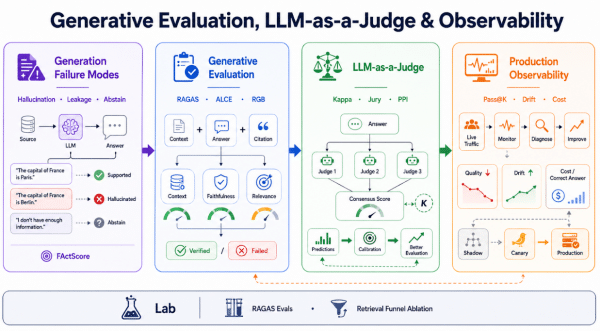
- Error Modes & Sins of Generation: Fluent substitution, intrinsic hallucination, parametric leakage, FActScore atomic decomposition, and abstinence-aware scoring rules.
- Generative Evaluation Frameworks: RAGAS Triad (Context Relevance, Faithfulness, Answer Relevance), citation verification with ALCE, and the Four RGB foundational abilities.
- LLM-as-a-Judge Calibration & Synthetic Data: Inter-annotator agreement (Cohen’s Kappa), ensemble jury panels, and Prediction-Powered Inference (PPI / ARES).
- Production Observability & Diagnostics: Pass@K metrics, silent decay monitoring, shadow/canary traffic routing, and cost-per-correct-answer optimization.
Lab
-
RAGAS Evals
-
Ablation Study on Retrieval Funnel
Focus
Key Takeaways:
- Historical Precedents & Epistemological Challenges: The Mundaneum precedent, spatiotemporal extents (“currently” problem), and provenance vs. empirical validation trust gradients.
- Open Knowledge Format (OKF): Minimalist Markdown bundle specification, front matter vs. body separation, progressive disclosure (`index.md`), and moving intelligence to authoring time.
- Cognitive Architecture & 4 Memory Tiers: Working memory, episodic session state, long-term semantic memory, and procedural tool playbooks.
- System Governance & Self-Annealing Knowledge: Git-backed knowledge bases, machine patrols vs. human adjudication, preventing corpus rot, and defenses against hallucination.
Lab
-
OKF bundle authoring and governance
-
Memory frameworks (to decide)
Focus
Key Takeaways:
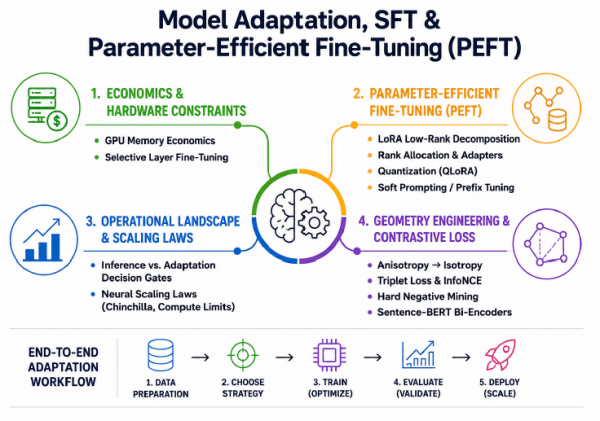
- Operational Landscape & Scaling Laws: Inference vs. adaptation decision gates, neural scaling laws, Chinchilla compute constraints.
- Geometry Engineering & Contrastive Loss: Anisotropy-to-isotropy transformation, Triplet loss, InfoNCE batch repulsion, hard negative mining, and Sentence-BERT bi-encoders.
- Economics & Hardware Constraints: GPU memory economics, and selective layer fine-tuning.
- Parameter-Efficient Fine-Tuning (PEFT): Mathematics of LoRA low-rank decomposition, rank allocation, quantization, and soft prompting / prefix tuning.
Lab
- Contrastive finetuning of text embedders and visualization
- Finetuning methods – full fine-tuning, LoRA, QLoRA, comparison with baseline
- Unsloth walkthrough
-
Eval of fine-tuned models
Focus
Key Takeaways:
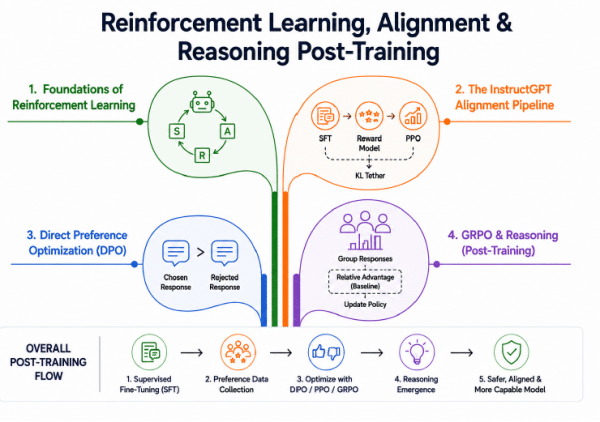
- Foundations of Reinforcement Learning: Markov Decision Processes (MDP), state-action value functions, policy gradients (REINFORCE), and the credit assignment problem.
- The InstructGPT Alignment Pipeline: 3-Step Methodology: SFT → Reward Modeling → PPO, KL-Divergence Tethering, and Reward-Hacking Defenses
- Direct Preference Optimization (DPO): Critic-free implicit reward derivation and pairwise preference loss without auxiliary reward models.
- Group Relative Policy Optimization (GRPO) & Reasoning: Baselines from group variance, DeepSeek R1 paradigm, and Reinforcement Learning with Verifiable Rewards (RLVR).
Lab
-
RL grid problem
-
PPO grid problem
-
PPO LLM
-
Basic TRL GRPO, DPO LLM
Focus
Key Takeaways
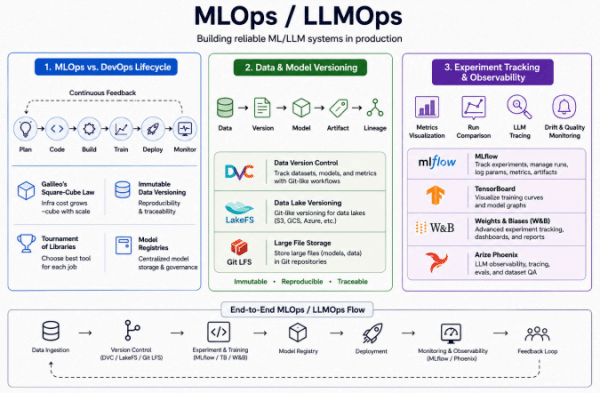
- MLOps vs. DevOps Lifecycle: Galileo’s Square-Cube law in infrastructure, immutable data versioning, tournament of libraries, and model registries.
- Data & Model Versioning: Managing dataset immutability, large-file tracking, and artifact lineage with DVC, LakeFS, and Git LFS.
- Experiment Tracking & Observability: Metric visualization, run comparison, and LLM tracing using MLflow, TensorBoard, Weights & Biases (W&B), and Arize Phoenix.
Lab
-
Dealing with Batched Inference with Observability
-
MLOps pipeline (AirFlow)
Focus
Key Takeaways:
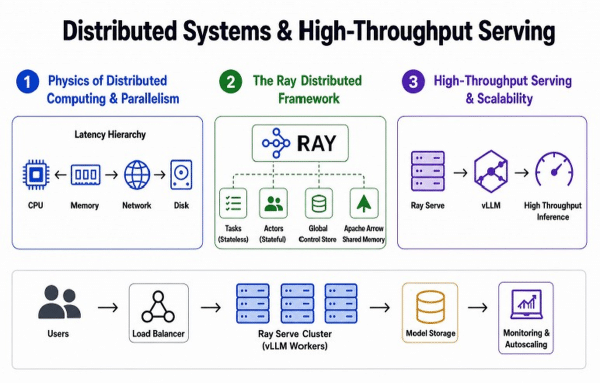
- Physics of Distributed Computing & Parallelism: Latency hierarchy, Data Parallelism (DDP, FSDP, DeepSpeed ZeRO), Tensor Parallelism, Pipeline Parallelism, and the CAP theorem.
- The Ray Distributed Framework: Hardware shift from Spark to Ray, Ray Tasks (stateless) vs. Ray Actors (stateful), Global Control Store, and Apache Arrow shared memory.
-
High-Throughput Serving & Scalability:
Ray Core, Ray Train, Ray Tune, Ray Serve with vLLM, continuous batching, and speculative decoding.
Lab
-
Ray core and Ray data
Teaching Faculty
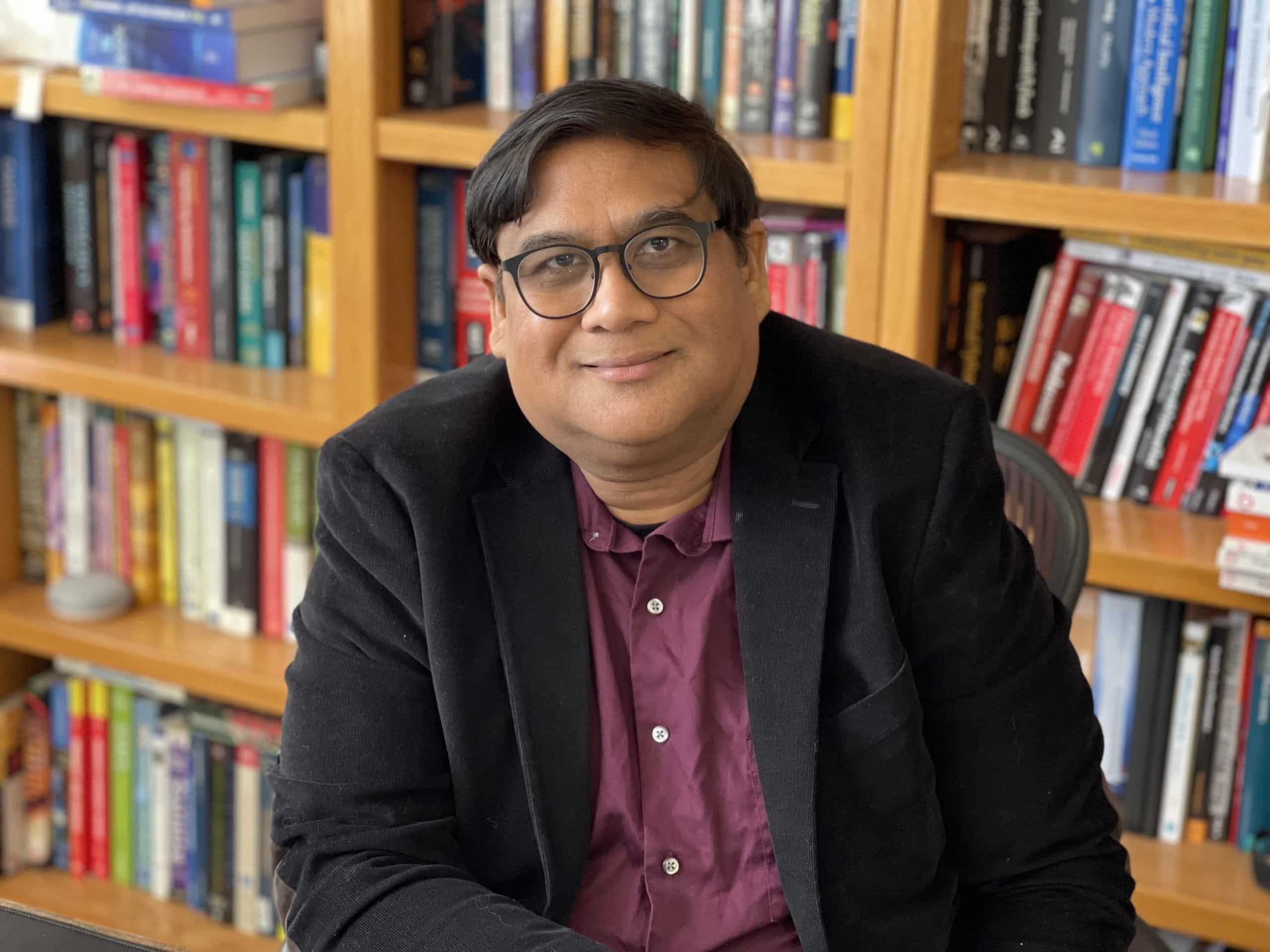
Asif Qamar
Chief Scientist and Educator
Background
Over more than three decades, Asif’s career has spanned two parallel tracks: as a deeply technical architect & vice president and as a passionate educator. While he primarily spends his time technically leading research and development efforts, he finds expression for his love of teaching in the courses he offers. Through this, he aims to mentor and cultivate the next generation of great AI leaders, engineers, data scientists & technical craftsmen.
Educator
He has also been an educator, teaching various subjects in AI/machine learning, computer science, and Physics for the last 32 years. He has taught at the University of California, Berkeley extension, the University of Illinois, Urbana-Champaign (UIUC), and Syracuse University. He has also given a large number of courses, seminars, and talks at technical workplaces. He has been honored with various excellence in teaching awards in universities and technical workplaces.
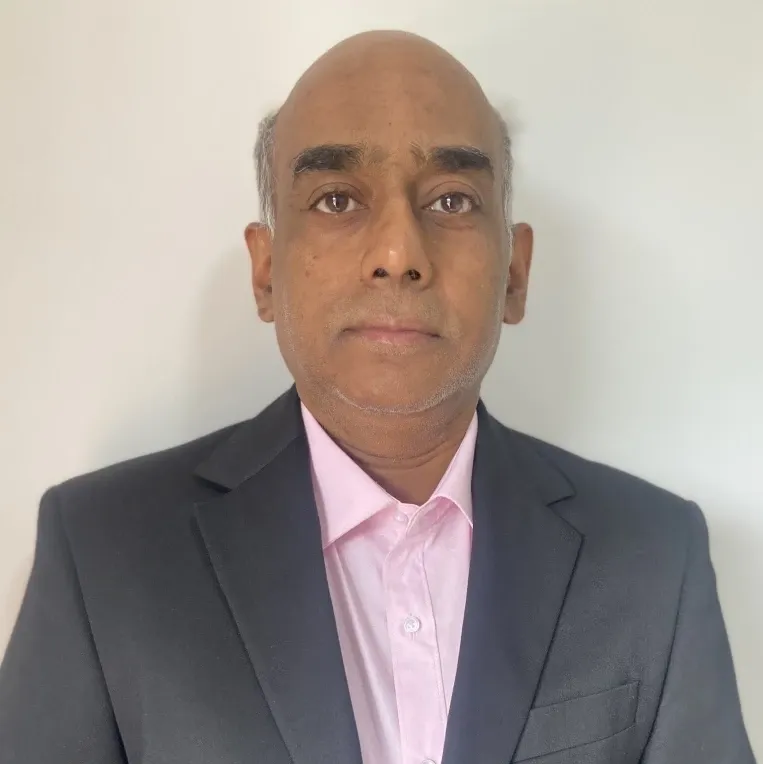
Chandar Lakshminarayan
Head of AI Engineering
Background
A career spanning 25+ years in fundamental and applied research, application development and maintenance, service delivery management and product development. Passionate about building products that leverage AI/ML. This has been the focus of his work for the last decade. He also has a background in computer vision for industry manufacturing, where he innovated many novel algorithms for high precision measurements of engineering components. Furthermore, he has done innovative algorithmic work in robotics, motion control and CNC.
Educator
He has also been an educator, teaching various subjects in AI/machine learning, computer science, and Physics for the last decade.

Krishnan Ramaswamy
Co-Instructor
Background
Krishnan Ramaswamy is an engineering leader, AI practitioner, and educator with an M.S. in Computer Science and Engineering and more than 25 years of industry experience. Throughout his career, he has designed and delivered large-scale platforms, enterprise applications, and AI/ML-driven solutions across Collaboration, Security, and Customer Experience domains. His expertise includes AI engineering, large language models, retrieval systems, agent architectures, distributed systems, and enterprise platform development. He is passionate about transforming emerging research into production-ready solutions that deliver measurable business value.
Educator
As a co-instructor at SupportVectors, Krishnan mentors engineers and technology professionals on modern AI engineering practices, helping them understand not only how AI systems are built, but also how they can be deployed, evaluated, governed, and scaled in enterprise environments. His teaching combines deep technical knowledge with real-world experience gained from decades of building and leading engineering initiatives.
Teaching Assistants
Our teaching assistants will guide you through your labs and projects. Whenever you need help or clarification, contact them on the SupportVectors Discord server or set up a Zoom meeting.

Kate Amon
Univ. of California, Berkeley

Shubeeksh K
MS Ramaiah Institute of Technology

Purnendu Prabhat
Kalasalingam Univ.

Harini Datla
Indian Statistical Institute

Kunal Lall
Univ. of Illinois, Chicago
In-Person vs Remote Participation
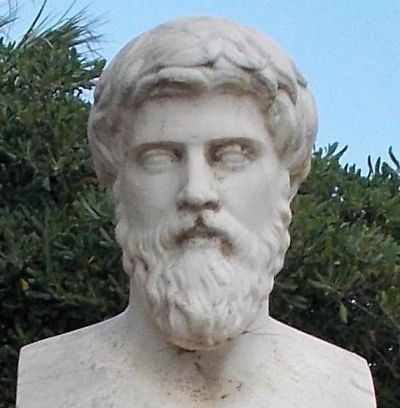
Plutarch
Education is not the filling of a pail, but the lighting of a fire. “For the mind does not require filling like a bottle, but rather, like wood, it only requires kindling to create in it an impulse to think independently and an ardent desire for the truth.
Our Goal: build the next generation of data scientists and AI engineers
The AI revolution is perhaps the most transformative period in our world. As data science and AI increasingly permeate the fabric of our lives, there arises a need for deeply trained scientists and engineers who can be a part of the revolution.
Over 3000+ AI engineers and data scientists trained
- Instructors with over three decades of teaching excellence and experience at leading universities.
- Deeply technical architects and AI engineers with a track record of excellence.
- More than 30 workshops and courses are offered
- This is a state-of-the-art facility with over a thousand square feet of white-boarding space and over ten student discussion rooms, each equipped with state-of-the-art audio-video.
- 20+ research internships finished.
Where technical excellence meets a passion for teaching
There is no dearth of technical genius in the world; likewise, many are willing and engaged in teaching. However, it is relatively rare to find someone who has years of technical excellence, proven leadership in the field, and who is also a passionate and well-loved teacher.
SupportVectors is a gathering of such technical minds whose courses are a crucible for in-depth technical mastery in this very exciting field of AI and data science.
A personalized learning experience to motivate and inspire you
Our teaching faculty will work closely with you to help you make progress through the courses. Besides the lecture sessions and lab work, we provide unlimited one-on-one sessions to the course participants, community discussion groups, a social learning environment in our state-of-the-art facility, career guidance, interview preparation, and access to our network of SupportVectors alumni.
Join over 3000 professionals who have developed expertise in AI/ML
Become Part of SupportVectors to Inculcate In-depth Technical Abilities and Further Your Career.